
OUR APPROACH
Social
Humanities led approach to AI challenges
* Most confounding problems with AI demand a social not just tech lens.
Regional
Global South focus: It is where the world’s majority lives!
* Global South are not mere data points but co-creators in AI design.
Empirical & solution driven
With feet on the ground in the Global South
* Our success is reflected in deep networks & credibility with local actors to institute change.
Stakeholder approach
Consortium members are critical changemakers
* Regulation is not sufficient to create sustainable change. We need to create change from within. We need all hands on deck from civic, industry, and policy sectors and North-South collaborations to make a difference.
Optimistic mindset
Hope-oriented
* We believe pessimism is a privilege for those who can afford to despair. We reclaim optimism from the tech evangelists by centering creative and generative practices globally that focus on social and planetary wellbeing.
FOCUS AREAS

This research cluster bridges responsible, sustainable AI with local entrepreneurship through pilot projects that integrate digital services and data impacts, aligning with both people and planet. By adapting existing frameworks like the UN’s ‘AI in Humanity,’ it translates policy into actionable, context-specific models, driving ethical, impactful AI adoption on the ground.

Team Member Wakanyi Hoffman speaks about Mothering AI systems with Ecosystemic Values and Indigenous Ways of Knowing

The Diversifying Creative AI cluster works across three layers: Data (addressing bias and self-representation through ethnographic research and diverse datasets), System (ensuring inclusive UX design by involving users to foster equitable, creative experiences), and Output (exploring quality, aesthetics, and cross-cultural value definitions with Global South creatives).

Team member and meme expert Lucie Chateau interviewed

Taste from the field from our project working with creative groups for equitable tool design

This cluster maps ethical AI campaigns to media gaps and focuses on identifying narrative gaps in different regions to tailor AI ethics outreach. By applying a cross-cultural lens to labeling and prompting, it fosters intercultural dialogue on AI ethics, aiming to define actionable design criteria that respect diverse values and needs across communities.

Team member Marianna Capasso presenting the module on Ethics of discrimination for the FINDHR Project funded by the European Union

This cluster focuses on enhancing data literacy to highlight both the opportunities and limits of data capture. It emphasizes the importance of the Global South as co-designers in AI, leveraging local knowledge to reduce risks and optimize relevance. The cluster also advocates for AI models that are both locally responsive and globally scalable.

Team member Kiran Bhatia presenting at the Living
Heritage in a Digital Environment Conference

This cluster works alongside FemLab—a researcher-activist cooperative co-founded by Prof. Arora—focuses on building inclusive, gender-sensitive AI systems. FemLab applies a worker-centered, feminist approach to digital platforms, aiming to enhance self-actualization, representation, and collective empowerment while ensuring technology aligns with human dignity and creativity.
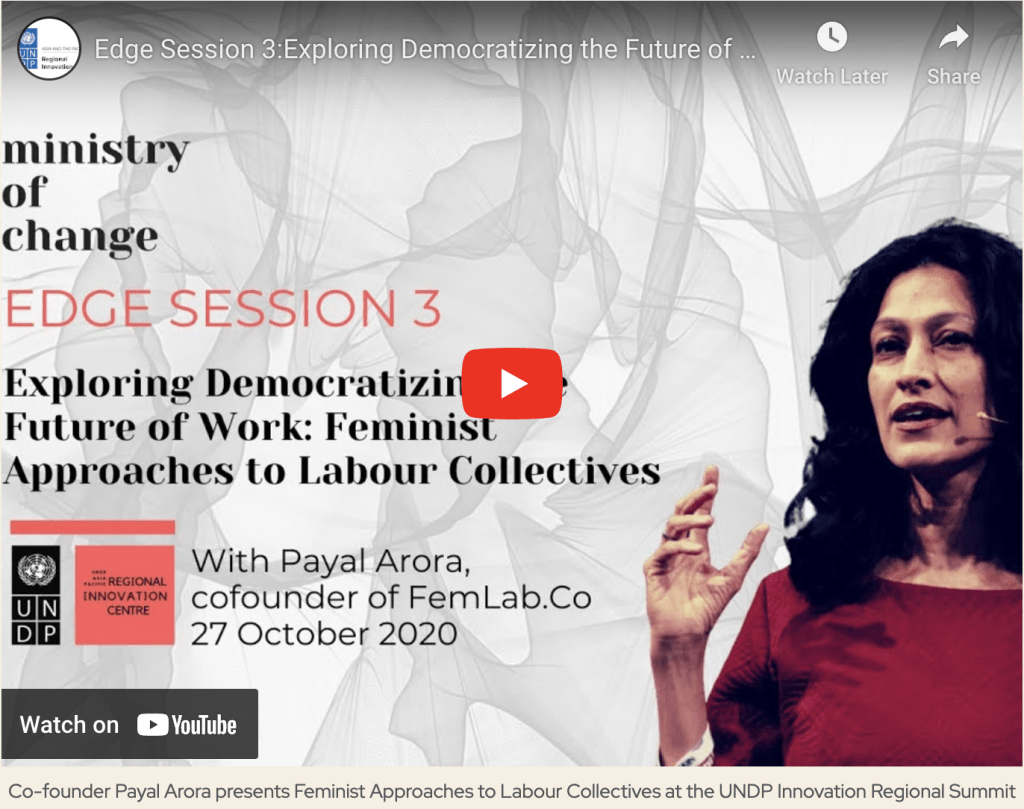
Co-founder Payal Arora presents Feminist Approaches to Labour Collectives
 inclusiveailab.org